

Who This Comparison Helps
The question of whether to pursue a Golden Visa or a D7 visa is one of the most common decisions facing non-EU nationals considering Portugal as a residence destination. Both programs offer legitimate pathways to Portuguese residency and eventual citizenship, but they are designed for fundamentally different profiles. The Golden Visa is an investment-based residence permit that requires a significant financial commitment but almost no physical presence in Portugal. The D7 is a passive income visa that requires minimal financial outlay but demands that you actually live in the country.
This comparison is written for people who have already decided that Portugal is their target destination and need to determine which residency pathway aligns with their financial situation, lifestyle preferences, and long-term goals. If you are a retiree or remote worker with steady passive income who wants to live in Portugal, the D7 is likely your route. If you are an investor or high-net-worth individual who wants the flexibility of Portuguese residency without relocating, the Golden Visa is designed for you. The nuances, however, are significant, and the wrong choice can result in unnecessary costs, tax exposure, or years of frustration.
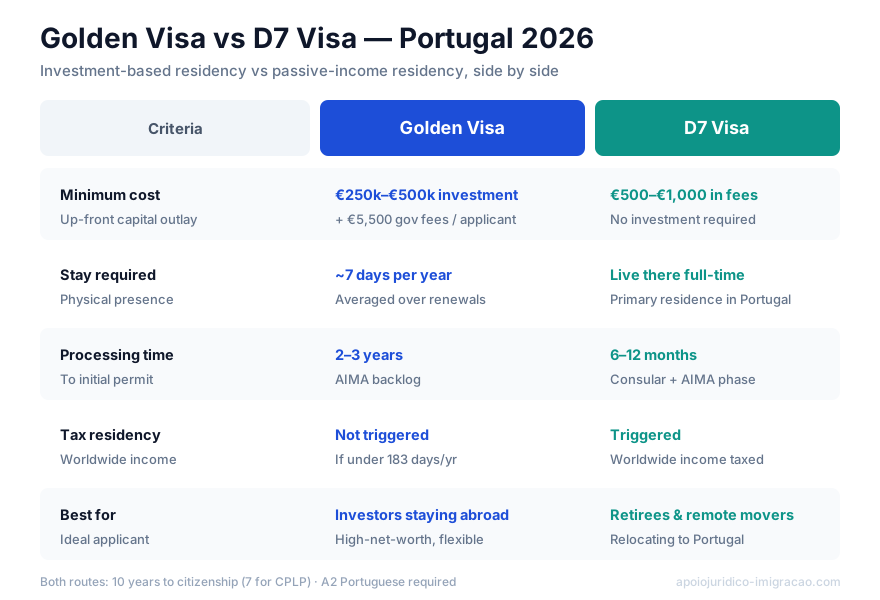
Quick Comparison Table
| Criteria | Golden Visa | D7 Visa |
|---|---|---|
| Cost | From €250K (cultural) or €500K (fund investment), plus €5,500 government fees and €5K-€15K legal fees | Application fees of approximately €500-€1,000 total; no investment required |
| Minimum stay requirement | Average of 7 days per year (can be averaged over 2-year renewal periods) | Must physically reside in Portugal as primary residence; cannot be absent for more than 6 consecutive months or 8 months total in a year |
| Can you work in Portugal? | Yes, the residence permit grants work rights, though most Golden Visa holders do not relocate | Yes, full work rights once residence permit is issued despite being called a "passive income" visa |
| Tax implications | No obligation to become Portuguese tax resident if you do not spend more than 183 days in Portugal | You become a Portuguese tax resident; worldwide income subject to Portuguese taxation |
| Processing time | Currently 2-3 years for initial permit due to AIMA backlog; new digital platform may improve this | 6-12 months total (consular phase 2-8 weeks, AIMA phase 3-5 months) |
| Path to citizenship | 10 years legal residence (7 for CPLP nationals); effective timeline 12-13 years due to processing delays | 10 years legal residence (7 for CPLP nationals); faster permit issuance means residency clock starts sooner |
| Family reunification | Spouse, dependent children, and dependent parents can be included; each dependent adds €5,500 in government fees | Spouse, dependent children can accompany; income threshold increases per dependent (approx. €410/month per spouse, €246/month per child) |
| Investment required | Yes, minimum €250K-€500K depending on route; capital locked for duration of permit | No investment required; must demonstrate ongoing passive income of approximately €820/month minimum |
| Flexibility | High: live anywhere in the world while maintaining Portuguese residency | Low: must make Portugal your primary home |
Golden Visa in Detail
The Portugal Golden Visa is a residence-by-investment program that grants a residence permit to non-EU nationals who make a qualifying investment in Portugal. Since the removal of real estate as a qualifying category in 2023, the primary route for most applicants is the fund investment pathway, which requires purchasing units in CMVM-registered Portuguese investment funds worth at least €500,000. Alternative routes include scientific research investment (€500,000 minimum), cultural and heritage support (€250,000 minimum), and company creation with job generation.
The Golden Visa's defining characteristic is its minimal physical presence requirement. Holders must spend an average of only 7 days per year in Portugal, one of the lowest thresholds in any European residence program. This makes the Golden Visa attractive for investors who want the benefits of Portuguese residency, including Schengen area travel, without uprooting their lives. The permit is initially issued for two years and renewed for successive two-year periods, provided the investment is maintained and the minimum stay requirement is met.
Pros
- Minimal physical presence requirement (7 days per year average)
- No obligation to become a Portuguese tax resident
- Schengen area travel rights for the holder and family members
- Investment may generate financial returns depending on fund performance
- Clear pathway to permanent residence and citizenship
Cons
- High upfront cost: minimum €250,000 to €500,000 investment plus fees
- Capital locked for the duration of the permit (typically 5 to 8 years for fund lock-up periods)
- Real estate no longer qualifies since 2023, limiting familiar investment options
- Significant AIMA processing backlog: initial permit can take 2 to 3 years to issue
- Government fees of approximately €5,500 per applicant at each stage
- Citizenship timeline extended to 10 years of legal residence (effective 12-13 years)
D7 Visa in Detail
The D7 visa is Portugal's residence pathway for individuals who can demonstrate regular passive income sufficient to support themselves without employment. Originally designed for retirees, the D7 has broadened to include anyone with qualifying passive income including pensions, investment returns, rental income, royalties, annuities, and similar sources. The benchmark income requirement is approximately €820 per month for a single applicant, based on the Portuguese minimum wage, with additional amounts for dependents.
Unlike the Golden Visa, the D7 requires you to physically live in Portugal as your primary residence. You cannot be absent for more than 6 consecutive months or 8 months total within a calendar year without jeopardizing your permit. This residency requirement is both the D7's strength and its limitation: it forces genuine integration into Portuguese life, which accelerates the practical aspects of building a life in Portugal, but it eliminates the flexibility to maintain your primary residence elsewhere.
Pros
- Very low cost: application fees total approximately €500 to €1,000 with no investment required
- Faster processing: 6 to 12 months from application to residence permit
- Full work rights in Portugal once the residence permit is issued
- Access to the Portuguese national health service (SNS)
- Family reunification available for spouse and dependent children
- Same citizenship pathway as the Golden Visa at a fraction of the cost
Cons
- Must physically reside in Portugal as your primary home
- Triggers Portuguese tax residency: worldwide income taxed in Portugal
- Must demonstrate ongoing passive income, which limits eligibility for some applicants
- Less flexibility: extended absences can result in permit revocation
- Relocation costs (housing, moving, establishing a new life) can be significant
Tax Considerations
Tax is often the deciding factor between the Golden Visa and the D7, and it is the area where the two pathways diverge most sharply. The D7 visa requires physical residence in Portugal, which means you automatically become a Portuguese tax resident. As a tax resident, your worldwide income is subject to Portuguese progressive income tax rates, which range from 14.5% to 48% depending on your total taxable income. This includes income earned outside Portugal: foreign pensions, investment returns, rental income, and any other global sources.
The Golden Visa, by contrast, does not require you to live in Portugal. If you spend fewer than 183 days per year in the country and do not establish your habitual residence there, you are not considered a Portuguese tax resident. This means your worldwide income remains taxed only in your country of actual residence. For high-income individuals, this distinction can represent tens or hundreds of thousands of euros in annual tax savings, making the Golden Visa's higher upfront cost a rational investment from a tax planning perspective.
The Non-Habitual Resident (NHR) tax regime, which previously offered favorable tax rates for new Portuguese tax residents during their first ten years, was formally ended for new applicants. It has been replaced by the IFICI regime (Incentivo Fiscal a Investigacao Cientifica e Inovacao), which offers tax benefits to a narrower category of qualifying professionals and researchers. Unlike the NHR, the IFICI is not broadly available to retirees or passive income earners, meaning most D7 visa holders will not qualify for preferential tax treatment. This change has made the tax implications of choosing the D7 over the Golden Visa more significant than they were during the NHR era. Professional tax advice from an advisor experienced with both Portuguese and your home country's tax system is essential before committing to either pathway.
Which Should You Choose?
The right choice depends on four factors: your budget, how much time you want to spend in Portugal, your tax situation, and your long-term goals. There is no universally better option. Each visa serves a distinct purpose, and choosing incorrectly can be costly and difficult to reverse.
Choose the Golden Visa if:
- You have at least €250,000 to €500,000 available for a qualifying investment and can afford to have that capital locked up for several years
- You do not want to live in Portugal full-time and prefer the flexibility to maintain your primary residence elsewhere
- You want to avoid becoming a Portuguese tax resident, particularly if you have significant worldwide income that would be subject to high Portuguese rates
- You value the option of European residency and Schengen travel without the commitment of relocation
- You are patient with the longer processing timeline and the extended path to citizenship
Choose the D7 Visa if:
- You genuinely want to live in Portugal and are ready to make it your primary home
- You have regular passive income of at least €820 per month but do not have €250,000 or more available for an investment
- You want your residency process completed faster, with a typical timeline of 6 to 12 months versus 2 to 3 years for the Golden Visa
- You are a retiree whose pension income may benefit from double taxation agreements, reducing the impact of Portuguese tax residency
- You want to work in Portugal, start a business, or fully integrate into Portuguese society
- You prefer a lower-cost pathway to permanent residence and citizenship
Consider your tax situation carefully
If you have significant income from investments, business interests, or high-value pensions, the tax implications of the D7 may outweigh its cost savings. A person earning €200,000 per year who becomes a Portuguese tax resident could face a marginal rate of 48%, whereas the same person holding a Golden Visa and remaining tax resident in a lower-tax jurisdiction could save a substantial sum annually. Over the 10-year residency period required for citizenship, the cumulative tax difference may far exceed the Golden Visa's investment requirement. Conversely, if your income is modest and primarily from a pension covered by a favorable double taxation agreement, the D7's tax impact may be minimal.
Frequently Asked Questions
Can I convert a Golden Visa to a D7 visa?
There is no direct conversion mechanism between the Golden Visa and the D7 visa. They are separate residence permit categories with different legal bases. However, you can hold a Golden Visa and later apply for a D7 visa if your circumstances change, provided you meet the D7 income requirements. You would effectively be switching residence permit types at your next renewal. In practice, this is uncommon because the Golden Visa's minimal stay requirement is its primary advantage, and switching to a D7 would require you to physically reside in Portugal. Consult a qualified immigration lawyer before attempting to change permit categories.
Which is cheaper in the long run?
The D7 visa is significantly cheaper in direct costs. The D7 requires proof of passive income (approximately €820/month minimum) and application fees totaling roughly €500 to €1,000. The Golden Visa requires a minimum investment of €250,000 to €500,000, plus government fees of approximately €5,500 per applicant and legal fees typically ranging from €5,000 to €15,000. However, the Golden Visa investment may generate financial returns, and the Golden Visa does not require you to become a Portuguese tax resident, which can represent substantial savings depending on your income. Over a 10-year period, the total cost comparison depends heavily on your individual tax situation and the performance of any Golden Visa investment.
Do I need to live in Portugal with a Golden Visa?
No. The Golden Visa has one of the lowest physical presence requirements of any European residency program. You are required to spend an average of only 7 days per year in Portugal to maintain your residence permit. This can be averaged over the two-year renewal periods. The Golden Visa is designed for investors who want Portuguese residency rights and eventual access to citizenship without relocating full-time. By contrast, the D7 requires you to make Portugal your primary residence.
Which leads to citizenship faster?
Both the Golden Visa and D7 visa require the same period of legal residence for citizenship eligibility: 10 years for most nationalities or 7 years for CPLP nationals under the revised nationality law. In practice, however, the D7 can lead to a shorter effective timeline because D7 applications are processed faster (6 to 12 months versus 2 to 3 years for the Golden Visa due to AIMA backlog). The sooner your initial permit is issued, the sooner your residency clock starts. Both routes require A2 Portuguese language proficiency for citizenship.
Can I combine both visas?
No. You cannot hold both a Golden Visa and a D7 visa simultaneously. Each is a separate residence permit category, and you can only hold one active residence permit in Portugal at a time. Choose the permit that best matches your current situation and long-term plans. If your circumstances change significantly, it is possible to apply for a different permit type at renewal, but this involves administrative complexity and should be done with legal guidance.