

What Is the D7 Visa
The D7 visa is Portugal's residence visa category for individuals who can support themselves through passive income sources without needing to work in Portugal. Originally designed primarily for retirees, the D7 has expanded in practice to cover a broader range of applicants including people with investment income, rental income, royalties, or other regular passive sources. It is one of Portugal's most popular visa categories among North Americans and Northern Europeans seeking a warmer climate and lower cost of living.
Unlike the Golden Visa, the D7 does not require a specific minimum investment and is considerably less expensive overall. However, it does require actual residence in Portugal, meaning you must live in the country as your primary home. This distinction makes the D7 suitable for people who genuinely want to relocate to Portugal, while the Golden Visa is designed for those who want residency rights without necessarily living there. The D7 provides a full residence permit with work rights, access to Portuguese healthcare, and a pathway to permanent residence and citizenship.
Income Requirements
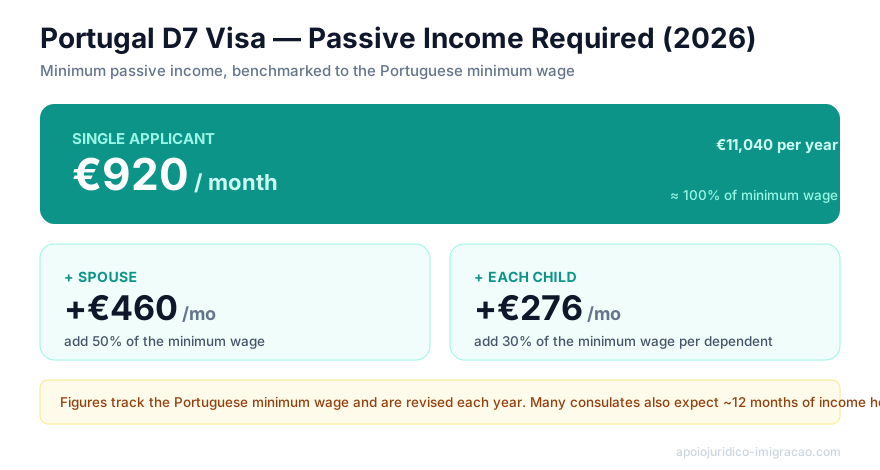
The D7 requires proof of regular, sufficient passive income to support yourself in Portugal without employment. While there is no officially fixed minimum, the general benchmark used by consulates and AIMA is the Portuguese minimum wage, currently approximately €920 per month for a single applicant. Additional amounts are required for dependents: roughly 50 percent of the minimum wage for a spouse and 30 percent for each child. These figures are guidelines rather than rigid thresholds, and consulates have discretion in assessing financial sufficiency.
The income must be regular and predictable, not one-time payments or irregular freelance earnings. Demonstrating at least 12 months of consistent income through bank statements and official documentation provides the strongest basis for your application. Some applicants supplement their regular income with savings, though the emphasis should be on ongoing income rather than depleting capital. If your income fluctuates, provide explanations and context that demonstrate the overall sustainability of your financial situation.
Qualifying Income Sources
Pension income is the most straightforward qualifying source for the D7 visa. This includes government pensions, private pension plans, military or government service pensions, and social security benefits from your home country. Investment income from dividends, interest, bonds, and similar financial instruments also qualifies. Rental income from properties you own outside Portugal is another accepted source, though you may need to demonstrate that the properties are managed without your active involvement.
Other qualifying sources include royalties from intellectual property, licensing income, annuity payments, and distributions from trusts or retirement accounts. The key characteristic is that the income is passive, meaning it does not require active work on your part. Some applicants with a mix of passive and active income find it helpful to clearly separate and document the passive components. If you are planning to transition from active work to passive income in order to qualify for the D7, ensure the transition is genuine and documentable before applying, as consulates may scrutinize situations that appear structured solely to meet visa requirements.
Application Process
The D7 application begins at a Portuguese consulate in your home country or country of legal residence. You submit your application with supporting documents including your passport, proof of passive income for at least the past 12 months, proof of health insurance, a criminal record certificate, proof of accommodation in Portugal (a rental contract or property purchase), and a personal statement about your reasons for relocating. Some consulates also require proof of Portuguese NIF registration and a Portuguese bank account, though requirements vary by consulate.
After receiving the D7 visa and arriving in Portugal, you apply to AIMA through the digital platform for your actual residence permit. The AIMA application requires similar documentation plus Portuguese-specific items. The initial residence permit is typically issued for two years, after which it can be renewed for successive three-year periods. Current AIMA processing times for D7 applications are approximately three to five months. The total timeline from initial consulate application to having a residence permit card in hand is typically six to twelve months when accounting for both the consular and AIMA phases.
Tax Considerations
As a D7 visa holder living in Portugal, you become a Portuguese tax resident, which means your worldwide income is subject to Portuguese taxation. Portugal's standard income tax rates are progressive and can be significant for higher earners. The Non-Habitual Resident (NHR) regime, which previously offered favorable tax treatment for new residents for their first ten years, has undergone changes. Check the current availability and terms of the NHR or any successor program, as the tax benefits can significantly affect the financial attractiveness of the D7 pathway.
Double taxation agreements between Portugal and many countries can prevent you from being taxed twice on the same income. For example, pension income from some countries may be taxed only in the country of origin under the applicable treaty, reducing your Portuguese tax burden. However, treaty provisions vary by country and income type, making professional tax advice essential before finalizing your relocation decision. Social security contributions are also a consideration, as D7 holders who are not employed in Portugal may still have obligations depending on their income sources and the social security agreements between Portugal and their home country.
Living in Portugal on a D7 Visa
D7 visa holders enjoy the same rights as other legal residents including access to the national health system, the ability to open bank accounts and sign contracts, and freedom to travel throughout the Schengen area. The requirement to actually live in Portugal means you should plan your relocation comprehensively, including finding suitable accommodation, setting up local banking and utilities, registering with a health center, and integrating into your local community. Many D7 holders settle in the Algarve for the climate, Lisbon for the culture and amenities, or smaller cities like Coimbra and Cascais for a balance of quality and cost.
The D7 community in Portugal is active and supportive, with many expatriate groups, social clubs, and online forums where D7 holders share experiences and advice. Learning Portuguese, while not immediately required for the D7 visa itself, is important for integration and will be needed if you eventually apply for permanent residence or citizenship. The cost of living in Portugal remains attractive compared to many Western European countries, though prices in Lisbon and popular tourist areas have risen significantly in recent years. A realistic budget and understanding of local costs before relocating helps avoid financial surprises.
The 2026 Nationality Law and Your D7 Timeline
The single most important change for anyone choosing the D7 in 2026 is not the income threshold but what happens at the far end of the pathway. Lei Orgânica n.º 1/2026, published in the Diário da República on 18 May 2026 and in force from 19 May 2026, extended the residence period required to apply for Portuguese citizenship from five years to ten years for most non-EU nationals (seven years for nationals of CPLP countries). For an American, British, Canadian, or Australian retiree relocating on a D7, this roughly doubles the wait to a Portuguese passport compared with the rules in place a year ago. The change does not affect the D7 itself — income rules, work rights, and the two-year-then-three-year permit cycle are unchanged — but it reshapes the long-term relocation maths, and the time count now runs from when your first residence permit is issued, not from the date you applied. We cover that distinction in detail in our guide to how residency time is counted toward citizenship.
What did not change is the route to permanent residence, which still becomes available after five years of legal residence. For many D7 holders, permanent residence — not citizenship — is the practical milestone: it secures indefinite legal stay and removes the renewal treadmill, even while the ten-year citizenship clock continues to run in the background. Investors weighing the D7 against the Golden Visa should note that the longer citizenship horizon now applies to both pathways, which has narrowed one of the Golden Visa's historical advantages; our D7 versus Golden Visa comparison walks through how the two routes stack up under the 2026 rules. Because the nationality law was settled and promulgated rather than pending, there is no transitional window left to "lock in" the old five-year rule by applying early — anyone starting a D7 in 2026 plans around the ten-year timeline from the outset.
Frequently Asked Questions
What is the minimum income required for the Portugal D7 visa in 2026?
The general benchmark used by Portuguese consulates and AIMA is the Portuguese minimum wage, currently approximately €920 per month (around €11,040 per year) for a single applicant. For a spouse, add roughly 50% of the minimum wage (approximately €460/month), and for each child, add 30% (approximately €276/month). These are guidelines rather than rigid thresholds, and consulates have discretion in assessing financial sufficiency. You must demonstrate at least 12 months of consistent passive income through bank statements and official documentation.
Can I work in Portugal on a D7 passive income visa?
Yes. Despite being called a "passive income" visa, the D7 residence permit grants full work rights in Portugal once issued. You can take up employment or start a business after receiving your residence permit. However, the visa application itself must be based on qualifying passive income sources — you cannot use future Portuguese employment income to qualify. The key requirement is proving sufficient passive income at the time of application.
How long does it take to get a Portugal D7 visa approved?
The total timeline from initial consulate application to having a residence permit card in hand is typically 6 to 12 months. This includes two phases: the consular phase (where the visa is processed, usually taking 2 to 8 weeks) and the AIMA phase (where your residence permit is issued after arriving in Portugal, currently taking approximately 3 to 5 months). Consulate appointment wait times vary by location and can add additional weeks to the process.
Can my family join me on a Portugal D7 visa?
Yes. Your spouse or registered partner and dependent children can accompany you or join you later through family reunification. They can apply simultaneously with you or after you receive your residence permit. Each dependent increases the income threshold you must demonstrate: approximately €460/month for a spouse and €276/month per child. Family members receive their own residence permits with the same rights, including access to Portuguese healthcare, education, and Schengen area travel.
Does the Portugal D7 visa lead to permanent residence and citizenship?
Yes. The D7 provides a clear pathway to both permanent residence and citizenship. After 5 years of continuous legal residence in Portugal, you become eligible for permanent residence. Under the revised nationality law, citizenship applications are accepted after 7 to 10 years of legal residence depending on your nationality (7 years for CPLP nationals, 10 years for most other nationalities). You must demonstrate basic Portuguese language proficiency (A2 level) and ties to the Portuguese community for citizenship.