

Current Investment Options
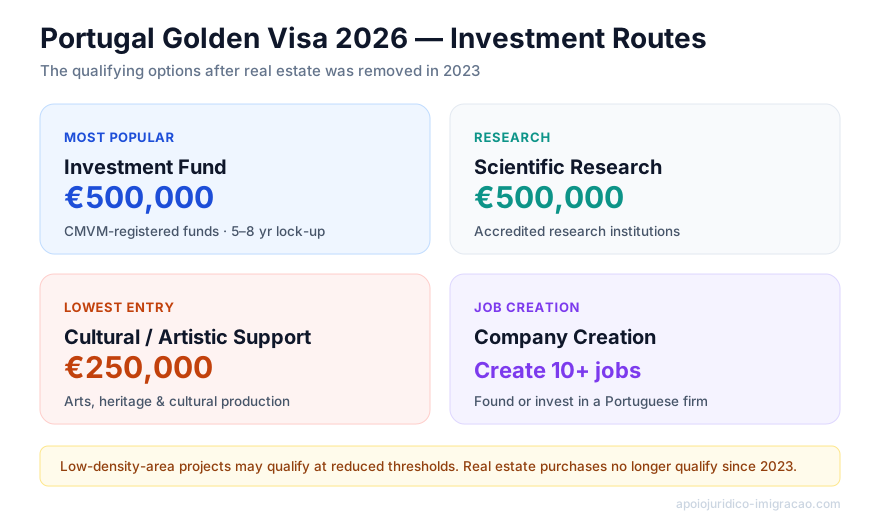
The Portugal Golden Visa program continues to offer residence-by-investment opportunities in 2026, though the eligible investment categories have changed significantly from the program's original format. The current qualifying investment routes include purchasing fund units worth at least €500,000, investing at least €500,000 in scientific research activities, investing at least €250,000 in support of arts and culture or the maintenance of national cultural heritage, and establishing a company in Portugal that creates a minimum number of jobs.
The minimum investment amounts vary by route and may qualify for reductions in certain circumstances, such as investments in low-density population areas. The €250,000 cultural investment route represents the lowest entry point and has attracted attention from investors seeking the most cost-effective path to Portuguese residence. However, the available cultural investment opportunities are more limited and require careful due diligence to ensure the investment qualifies under AIMA's criteria. Working with a specialized Golden Visa advisor who understands the current rules and has relationships with qualifying investment opportunities is essential for navigating this process effectively.
Why Real Estate Was Removed
The most significant change to the Golden Visa program was the removal of real estate as a qualifying investment category. Property purchases, which were by far the most popular route used by Golden Visa applicants, were eliminated due to concerns about the program's impact on Portugal's housing market. The government argued that foreign investment in residential real estate was driving up property prices, particularly in Lisbon and Porto, making housing increasingly unaffordable for Portuguese residents and contributing to a broader housing crisis.
The decision was controversial, with the real estate industry and some economists arguing that Golden Visa investment represented a small fraction of total real estate transactions and that other factors, including tourism, low housing construction, and domestic demand, were more significant drivers of price increases. Regardless of the debate, the change is firmly in place and there is no indication that real estate will be reinstated as a qualifying category. Investors who had planned to use the property route must now explore the remaining options, which require different expertise and involve different risk profiles than direct real estate ownership.
Fund Investment Route
The fund investment route has become the primary pathway for most new Golden Visa applicants. This route requires purchasing units in qualifying Portuguese investment funds worth at least €500,000. The funds must be registered with the Portuguese Securities Market Commission (CMVM) and must invest a minimum percentage of their capital in Portuguese companies or projects. The funds cannot be exclusively invested in real estate, consistent with the program's shift away from property investment.
Selecting the right fund is critical and requires careful analysis of the fund's investment strategy, track record, management team, fee structure, and liquidity terms. Golden Visa-qualifying funds typically have lock-up periods of five to eight years, meaning your capital is committed for an extended period. Returns are not guaranteed and depend on the fund's investment performance. Some funds focus on venture capital and startup investments, others on established Portuguese companies or infrastructure projects. Independent financial advice, separate from any fund promoter's recommendations, is essential for making an informed investment decision that aligns with your financial goals and risk tolerance.
Scientific Research and Cultural Support
Investing in scientific research requires a minimum of €500,000 directed to research activities conducted by Portuguese public or private institutions. This route appeals to investors with an interest in science and innovation and can involve partnerships with Portuguese universities, research institutes, or technology companies. The investment must be genuine and verifiable, meaning it must result in actual research activity rather than serving solely as a vehicle for immigration purposes.
The cultural support route, requiring a minimum of €250,000, involves investments in arts, culture, or national heritage preservation. Qualifying investments include contributions to the renovation of heritage buildings, support for cultural institutions, funding for artistic productions, and other activities that promote Portuguese culture. This is the most affordable Golden Visa route but also the most limited in terms of available opportunities and the least likely to generate financial returns. The investment should be viewed primarily as an immigration cost with cultural impact rather than as a financial investment, though some cultural projects may generate modest returns through tourism or other revenue streams.
Application Process in 2026
The Golden Visa application process in 2026 operates through a new fully digital platform launched in January 2026. All applications and renewals must be submitted entirely online, with integrated payment processing and document upload capabilities. The platform represents a significant improvement over the previous system, which required a combination of online and in-person steps. Biometric data collection, which previously required an in-person appointment before application processing, now occurs only after application approval, streamlining the sequence and reducing unnecessary appointments.
Despite the digital improvements, processing times remain a concern due to the accumulated backlog of pre-platform applications. The government has promised to clear the Golden Visa backlog by the end of 2026, but historically these timelines have not been met. New applications submitted through the digital platform should theoretically benefit from faster processing than the legacy cases, but the overall system capacity is still stretched. Having all documentation prepared meticulously before submission, working with a qualified legal representative, and monitoring your case actively through the platform are the best strategies for minimizing your processing time.
Citizenship Pathway Changes
Golden Visa holders can eventually apply for Portuguese citizenship, but the pathway has become longer under the revised nationality law. The residence requirement for citizenship has increased from five years to ten years for most nationalities and seven years for CPLP nationals. Given that it typically takes two to three years for AIMA to issue the initial residence permit due to processing delays, the effective timeline to citizenship through the Golden Visa route is now approximately twelve to thirteen years from initial application.
This extended timeline significantly changes the value proposition of the Golden Visa program. Investors must maintain their qualifying investment for the entire residence period, which means their capital is committed for over a decade if citizenship is the goal. The requirement to spend an average of seven days per year in Portugal during the residence period remains manageable but requires ongoing commitment. For investors primarily motivated by citizenship rather than lifestyle, the extended timeline may make other countries' investment citizenship programs more attractive. For those who genuinely want to live in or regularly visit Portugal, the Golden Visa remains a viable pathway despite the longer timeline to citizenship.
Frequently Asked Questions
What is the minimum investment amount for the Portugal Golden Visa in 2026?
The minimum investment depends on the route chosen. The lowest entry point is €250,000 for cultural support and national heritage preservation. The fund investment route and scientific research route both require a minimum of €500,000. Company creation requires establishing a business that creates a minimum number of jobs. Investments in low-density population areas may qualify for reduced thresholds. The €250,000 cultural route is the most affordable but offers the fewest investment opportunities and is unlikely to generate financial returns.
Can I still buy property to get a Portugal Golden Visa?
No. Real estate purchases were removed as a qualifying investment category for the Golden Visa program. The Portuguese government eliminated the property route due to concerns about its impact on the housing market, particularly rising prices in Lisbon and Porto that were making housing unaffordable for Portuguese residents. There is no indication that real estate will be reinstated. The remaining qualifying routes are fund investments (€500,000 minimum), scientific research (€500,000 minimum), cultural support (€250,000 minimum), and company creation with job creation.
How many days per year must I stay in Portugal with a Golden Visa?
Golden Visa holders are required to spend an average of only 7 days per year in Portugal to maintain their residence status. This is one of the lowest physical presence requirements of any European residence-by-investment program, making the Golden Visa attractive for investors who want Portuguese residency rights without relocating full-time. The 7-day requirement can be averaged over the two-year renewal periods, giving flexibility in when you visit.
Does the Portugal Golden Visa lead to citizenship?
Yes, but the timeline has been significantly extended. Under the revised nationality law, the residence requirement for citizenship has increased to 10 years for most nationalities (7 years for CPLP nationals). Given that AIMA typically takes 2 to 3 years to issue the initial residence permit due to processing delays, the effective timeline from initial application to citizenship eligibility is approximately 12 to 13 years. You must maintain your qualifying investment for the entire residence period and demonstrate basic Portuguese language proficiency (A2 level) when applying for citizenship.
How long does it take to process a Portugal Golden Visa application in 2026?
In 2026, Golden Visa applications are submitted through a new fully digital platform launched in January 2026. While the platform has streamlined the process, processing times remain affected by a significant backlog of pre-platform applications. The government has promised to clear the backlog by the end of 2026, though historically these timelines have not been met. New applications through the digital platform should benefit from faster processing than legacy cases. Having complete documentation and working with a qualified legal representative helps minimize processing time.