

Income Threshold for 2026
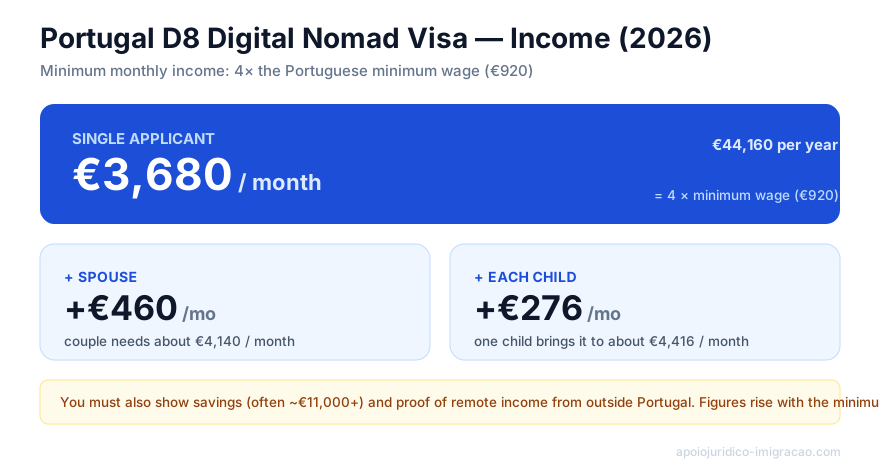
The official Portugal D8 digital nomad visa income requirement for 2026 is €3,680 per month (about €44,160 per year). This figure is not a consultancy estimate — it is fixed by law as four times the Portuguese national minimum wage, which the government raised to €920 per month for 2026. Because the threshold is a statutory multiple of the minimum wage rather than a standalone number, it updates automatically each year when the minimum wage changes; the €3,680 figure is the correct official requirement for any D8 application submitted during 2026.
The Portugal D8 Digital Nomad Visa requires applicants to earn at least four times the Portuguese national minimum wage. With the minimum wage rising to €920 per month in 2026, the official income requirement for the D8 visa in 2026 is €3,680 per month, or approximately €44,160 per year. This income must come from work performed remotely for a company or clients based outside Portugal. The threshold is designed to ensure that digital nomads can support themselves comfortably while contributing positively to the Portuguese economy without competing for local jobs.
The income requirement is assessed based on your earnings at the time of application and must be sustainable rather than a one-time spike. Consulates look for consistent income over a period of at least three to six months preceding the application. Simply having €44,160 in savings does not satisfy the requirement, as the visa specifically targets active income from remote work. However, the legal requirement also specifies having 12 months' worth of the required income available in a Portuguese bank account at the time of application, which means having approximately €44,160 accessible in your Portuguese bank account alongside proof of ongoing income generation.
How to Prove Your Income
For employed remote workers, the primary proof of income is your employment contract showing your salary, accompanied by recent pay slips covering at least three months. The contract should clearly indicate that the work is performed remotely and that the employer is based outside Portugal. Bank statements showing regular salary deposits corresponding to your contract terms provide additional verification. If your employment contract does not explicitly mention remote work, a letter from your employer confirming the remote arrangement is essential.
For freelancers and independent contractors, proof of income is more complex but still manageable. You need to show a pattern of invoicing and receiving payments that meets the threshold. Client contracts, invoices from the past three to six months, and bank statements showing corresponding deposits form the core evidence. Tax returns from your home country showing your annual income provide official verification. If your income fluctuates month to month, as is common for freelancers, demonstrating that your average monthly income over a six to twelve-month period exceeds the threshold is generally accepted, provided the fluctuation is not extreme.
Eligible Work Types
The D8 visa covers remote work for foreign entities, which includes employment by companies registered outside Portugal, freelance work for international clients, and income from digital businesses operated outside Portugal. Software development, design, writing, consulting, marketing, project management, and other knowledge-economy roles that can be performed remotely all qualify. The key criterion is that your work and income source are foreign, meaning you are not employed by or primarily serving a Portuguese company or the Portuguese market.
Some situations create ambiguity about eligibility. Working for a foreign company that has a Portuguese subsidiary may or may not qualify, depending on whether your contract is with the foreign parent company or the local entity. Freelancers who serve a mix of international and Portuguese clients may need to demonstrate that the majority of their income comes from foreign sources. Running an online business that generates passive income such as affiliate marketing or digital products may not fit neatly into the D8 category, as the visa is designed for active remote work rather than passive income, which would be better suited to the D7 visa category.
Application Process Step by Step
The D8 application begins at a Portuguese consulate in your country of residence. Schedule a consulate appointment as early as possible, as some consulates are booking two to four months out. Prepare your documentation package including your passport with at least six months validity, proof of income meeting the threshold, employment contract or proof of freelance activity, proof of accommodation in Portugal through a rental agreement, health insurance valid in Portugal, criminal record certificate, and proof of Portuguese bank account with the required funds.
After submitting at the consulate, processing typically takes two to eight weeks depending on the consulate's workload. Once your D8 visa is issued, it is valid for four months and allows two entries into Portugal. After arriving, you must apply for a residence permit through AIMA's digital platform within the visa validity period. The AIMA application requires the same documentation plus proof of your Portuguese address registration. The residence permit, once issued, is initially valid for two years and can be renewed for successive three-year periods, provided you continue to meet the income and activity requirements.
Family Member Income Additions
If you are bringing family members to Portugal under the D8 visa, the income requirement increases. For a spouse or partner, an additional 50% of the minimum wage (€460 per month in 2026) is typically required, bringing the total to approximately €4,140 per month for a couple. Each dependent child adds a further 30% of the minimum wage (€276 per month), so a family of two adults and one child would need to demonstrate approximately €4,416 per month in income.
Family members apply for their visas simultaneously with the primary applicant or through family reunification after the primary applicant has established residence. If applying simultaneously, all family documentation including marriage certificates, birth certificates, and proof of relationship must be included. The new two-year waiting period for family reunification applies to the D8 visa, so if family members are not included in the initial application, the primary applicant may need to wait two years before bringing them. Planning your family's move comprehensively from the outset avoids this waiting period and is strongly recommended.
Renewal and Ongoing Requirements
The D8 residence permit must be renewed after the initial two-year period and then every three years. Renewal requires demonstrating that you continue to meet the income threshold, are still engaged in remote work for foreign entities, have maintained your tax compliance in Portugal, and have not been absent from Portugal for extended periods that would undermine the purpose of your residence permit. Providing updated income documentation, tax returns filed in Portugal, and proof of social security registration or contributions is required.
An important consideration for D8 holders is the tax treatment of their income. Portugal has moved away from the favorable NHR tax regime, and the replacement IFICI program has different eligibility criteria that may or may not apply to digital nomads. Understanding your tax obligations in Portugal, including income tax, social security contributions, and any obligations in your home country under double taxation agreements, is essential for maintaining compliance. Non-compliance with tax obligations can affect your permit renewal and should be managed from the start of your residence with the help of a qualified Portuguese accountant or tax advisor.